Hydraulic Aspects of Irrigation Systems: Design Guide
Mastering Hydraulics: Engineering the Future of Global Irrigation Infrastructure.
MMehdi Mohebbi
· 30 min read· 90 views

Mastering Hydraulics: Engineering the Future of Global Irrigation Infrastructure.
Quick answers to common questions.
As we know, irrigation significantly impacts global freshwater resources, world food production, and the aesthetics and value of landscapes. Approximately one-third of the world’s food is grown on just 21% of the cultivated land that receives irrigation [2] (Eisenhauer et al., 2021). How much land do you think is under irrigation in the whole world? 20 million acres? 40 million acres? Or 100 million acres? To get the answer to this question, we take a look at the history of irrigated lands.
At the beginning of the 1800s, the global irrigated land was approximately 20 million acres. The first barrages, or short diversion dams, were built in the Nile Delta in about 1850. German immigrants founded an irrigation colony in Anaheim, California, in 1857, and in 1870, they established another irrigation colony in Greeley, Colorado. By the end of the nineteenth century, experts estimated that the global irrigated area encompassed 100 million acres. Today, the total irrigated area exceeds 800 million acres[3] (Gulhati., 1973; Eisenhauer et al., 2021).
However, based on research, large irrigation projects have an efficiency rate of 30 to 35%[4] (Singh et al., 1997). But why so little? One of the main reasons is to consider the hydraulic aspects of the irrigation systems, which are very useful in their design. Therefore, to reduce costs and components and enhance efficiency by minimizing water consumption, the proper design of irrigation systems requires utilizing hydraulic principles.

Hydraulics, a scientific discipline, primarily focuses on the behavior of liquid analyzing, particularly water, in motion or at rest. Based on the science of hydraulics, we will understand that hydraulic investigation of irrigation systems includes 1) the impact of both static and dynamic pressure on the functioning of sprinklers; 2) the factors that decrease or increase in pressure within an irrigation system; 3) the connections between flow, pressure, and within an irrigation system; 4) the method for determining dynamic and static pressure at different locations within an irrigation system; and 5) the process of assessing the pressure losses caused by the flow of water through fittings and pipes (Hunter Industries).
There are three general types of irrigation systems: 1) Sprinkler irrigation, including center pivot and traveling gun irrigation systems[6] ; 2) Surface irrigation, including basin, border, and furrow systems; 3) Micro-irrigation, including drip, trickle, and spray; and 4) Sub-irrigation system. This paper aims to introduce hydraulic aspects of irrigation systems, acknowledging that each approach has advantages and disadvantages depending on the given situation (Bjorneberg, 2013).
For deeper insights into “Types of Irrigation Systems” explore the full article.[7]
Hydraulic characterization assessment for irrigation structures is important for irrigation system design. Therefore, we will continue the discussion on the design of irrigation systems, focusing on key considerations such as required pressure, pump power requirements, and flow characteristics.
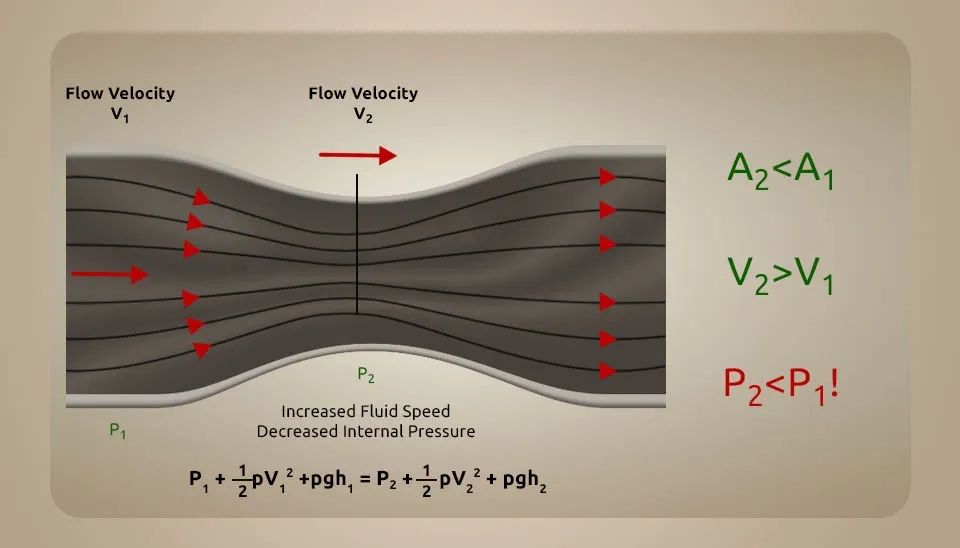
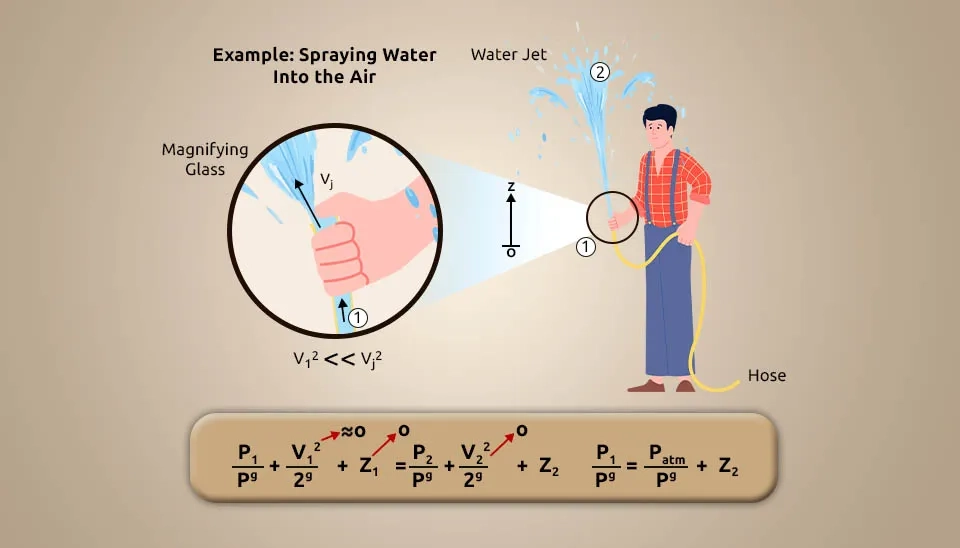
Water pressure plays a crucial role in making irrigation systems work effectively. [8] When water gets supplied to an irrigation system under pressure, it creates the force necessary to move water through the system and distribute it to the desired areas. A pump or water source at a higher elevation typically generates the pressure. This paper focuses more on pump pressure because most irrigation systems utilize pumps. Adjusting the operating pump pressure is crucial to ensuring the appropriate pressure at the inlet of the lateral lines within the irrigation system network. This step holds significant importance in facilitating water movement through the system. In this case, Bernoulli’s equation is applied as follows (Morad et al., 2013)
Ep = EL + hL
EP = total energy at the pump outlet
EL = total energy at the lateral line inlet
hL = total energy losses between the pump outlet and lateral line inlet.
The equation of Bernoulli is written in the following form as well.
ZP + ( VP2 / 2g ) + (Pp / W ) = ZL + ( ZL + ( VL2 / 2g ) + ( PL / W ) + hL
Where,
ZP , ZL = Potential heads at the pump outlet and the lateral line inlet
VP2 , VL2 = Kinetic heads at the pump outlet and the lateral line inlet
(Pp / W ) , ( PL / W ) = Pressure heads at the pump outlet and the lateral line inlet
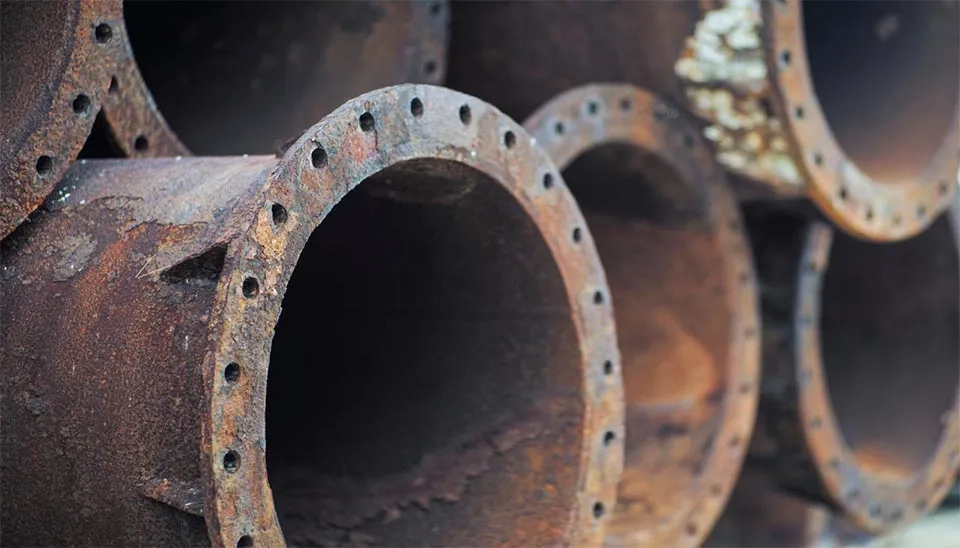
Fig. 3. Example of the hydraulic performance of irrigation systems in real life
The expression of the total head losses can be as follows,
hL = hƒ + hs
hƒ : Friction losses between the pump outlet and lateral line inlet
hs : Secondary losses between the pump outlet and lateral line inlet
The resistance caused by friction in pipes and valves poses a challenge to the process industry's transportation of fluids in the pipelines. [9] While the transportation of fluids relies on the volume of fluid and the capacity of the pump and pipeline, the characteristics of the fluids in transit also play a significant role. These properties dictate whether the fluid will flow smoothly or experience significant resistance (Ntengwe et al., 2015). However, for water fluid, we can use the relation to calculate the frictional head loss (Celik et al., 2015)
hƒ = (( ƒ * L ) / ( D )) * (V2 / 2g )
Where
hƒ = Friction head losses, m
L = Length of pipe, m
V = Inside diameter of pipe, m
D = Velocity, m.s-1
g = Acceleration due to gravity, m.s-2
ƒ = Friction coefficient
Head losses due to the insertion of emitters are calculated using the following equations (Celik et al., 2015)
hs = k * (V2 / 2g )
hs = secondary head losses, m
V = Velocity (m.s-1)
g = Acceleration due to gravity, m.s-2
k = Coefficient factor
The power imparted to the water by the pump is called water power. To determine the power of water, one must know the flow rate and the pump head. The following equation will determine the required pump power (Kang'au et al., 2011).
Power ( Kw ) = (( Q / H )* 1.2) / (360 * Ep)
where
Q = discharge (m3/hr),
H = head (m),
Ep = pump efficiency,
360 = conversion factor for the metric unit,
1.2 = 20% derating.
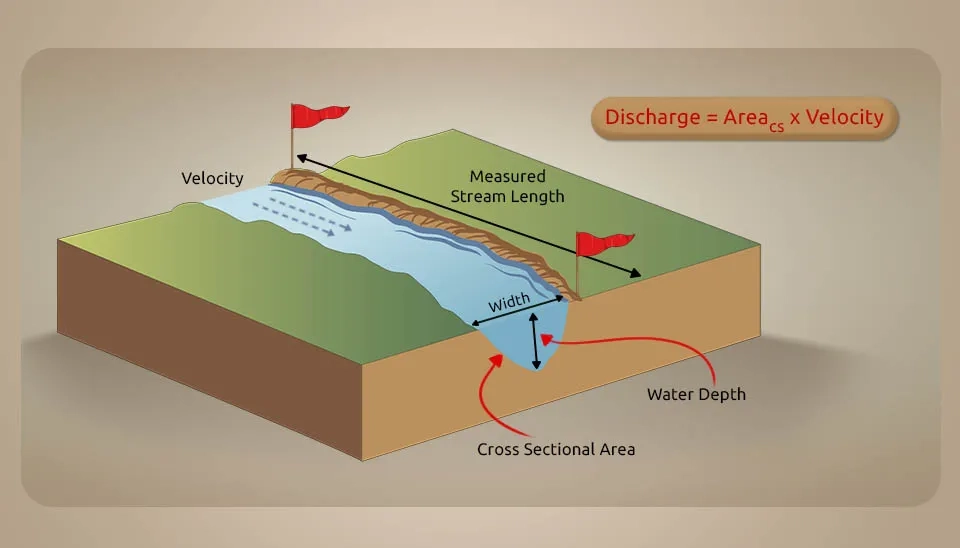
Flow specifications for emitters in irrigation systems include flow velocity, discharge, and head. The discharge of the emitter is determined by collecting the water volume over time. Therefore, we divide them into discharge pressure relations and flow regime transitions (Li et al., 2006).
A general empirical formula, valid over a narrow range of operating pressure and characterizing the discharge-pressure relationship of various types of emitters, is
q = kHx
where q is the discharge from the individual emitter, H is the hydraulic head at the inlet of the emitter, k is the discharge coefficient of the emitter, and x is the discharge exponent, can be determined by conducting a regression analysis between pressure values at constant temperature and the measured emitter flowrate of the emitter. The coefficient x varies depending on the flow regime within the emitter, with assumed values of 1 for laminar flow regimes and 0.5 for fully turbulent flow regimes (Senyigit et al., 2012).
The average velocity on the cross-section of the flow path (v) was studied, which can be expressed as follows:
ʋ = q /A
A = Wmin or Wmax * D
Where A is the area of the cross-section of the flow path Wmin and Wmax are the minimal and maximal widths of the flow path, respectively, and D is the depth of the flow path (Li et al., 2006).
Water application at the appropriate time, rate, quantity, and desired location is crucial to achieving management objectives. However, imperfections in irrigation systems can lead to uneven water distribution, resulting in some areas receiving more water than intended. Therefore, we have given important parameters for evaluating the efficiency of irrigation systems[10] (Eisenhauer et al., 2021).
WAE measures the effectiveness of the irrigation system in storing water in the crop root zone. It is expressed as the percentage of the average depth of the irrigation water stored in the root zone to the average depth of irrigation water applied, expressed as a percent (Taye et al., 2008).
AE = (WDZ / DT ) * 100
Where WDZ the depth of water is stored in the root zone, and DT is the gross depth of the water.
Irrigation systems exhibit variations in water distribution due to factors like wind drift, improper pipeline pressure, design flaws, and inadequate system management. This non-uniformity leads to differing depths of water infiltration and varying soil water levels within the root zone, negatively impacting plant performance. Therefore, obtaining data on water application uniformity is crucial for effectively managing irrigation systems. One of the indices to indicate application uniformity is the Christiansen uniformity coefficient (Eisenhauer et al., 2021).
CU = 100 * ( 1 - ∑(( di – dz) / ndz))
di is the depth of observation i, dz is the mean depth of infiltration for all observations, and n is the number of observations.
Fig. 6. Well uniformity is one of the hydraulic performances on Irrigation systems
The emitter manufacturer gives the coefficient of variation, which measures discharge variability. It shows how the amount of fluid moving through a certain point in the system changes over time. Flow rate variation can be calculated using the following equation (Mistry et al., 2017).
qvar =100 * ( 1 – (qmax / qmin )
qmax and qmin are the maximum and minimum flow rates, respectively; qvar , more than 20% is not acceptable. Flow rate variations can occur due to several factors, including changes in pressure, system dynamics, pipe sizing, valve setting, or variations in the fluid properties.
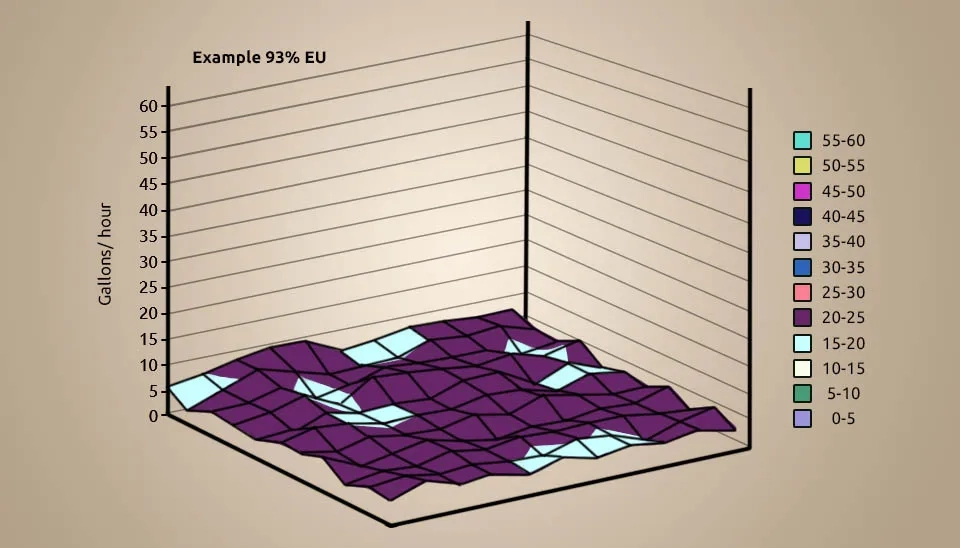
Emission Uniformity (EU) measures the evenness of water application across a designed area, making it crucial for efficient irrigation scheduling. This measurement is essential for efficient irrigation scheduling, as emission uniformity plays a significant role in indicating the performance of the irrigation systems. [11] The higher levels of the EU are considered vital, as they contribute to more efficient water usage and maximize crop health. Every grower aims to achieve high water use efficiency because it can lead to lower production costs and increased profit margins. The emission uniformity of systems was determined in the field as a percentage using the EU test and calculated using the following equation (Barragan et al., 2010).
EU = Qn / Qa
Qn = the average discharge for the lowest one-fourth of the field-measured emitter discharges
Qa = the average discharge of all the emitters checked in the field
The overall irrigation efficiency represents the efficiency of the entire physical system and operating decisions in delivering irrigation water from a water supply to the target crop. We calculated the irrigation system efficiency using the following formula (Irmak et al., 2011):
Es = AE * EU
Irrigation systems can be classified into four categories: surface, sprinkler, micro, and sub-irrigation. While the characteristics of each system differ, none applies water perfectly to an irrigated area.[12] There is never an even distribution of water across the land, and some water instead goes to evaporation, runoff, and deep percolation. Common terms can be used to describe how efficiently irrigation systems apply water. The uniformity coefficient is used as an index of water application uniformity. Application efficiency of the low quarter is used to describe what proportion of the applied water is stored in the soil and available to plants. However, to further investigate the hydraulic effects on the design of irrigation systems, it is necessary to check other parameters, including system safety, system capacity, and sustainable development criteria of the irrigation system, so that the irrigation system can be designed and used correctly.
Keep reading










Comments
No comments yet
Be the first to comment
Share your thoughts and start the conversation.